By CHRISTIAN CONRAD, Assistant Coach, University of Arizona
In May, the NFCA proudly celebrated Asian Pacific Islander Desi American Heritage Month (APIDA).
The month is meant to celebrate members of the community who represent East and Southeast Asia, South Asia, Native Hawaiians and Pacific Islanders.
Members of the APIDA community are found throughout college softball. Coaches like Melissa Inouye at Fordham University, Kirin Kumar at Ohio State University, Samantha Ricketts at Mississippi State University, Amber Freeman at the University of Arizona, and Mysha Sataraka at UCLA. Coast to coast, the impact of these coaches is felt and seen by hundreds of softball players.
As reported by National Public Radio (NPR) in 2023, May was selected to honor APIDA heritage because of two significant dates. “May 7, 1843, marks the arrival of the first Japanese immigrants to the United States. And May 10, 1869, or Golden Spike Day, recognizes the completion of the first transcontinental railroad in the U.S., which had significant contributions from Chinese workers,” they explained.
The NFCA is proud to celebrate the coaching achievements of members of the APIDA community from the grassroots of travel ball all the way to the Olympic stage.
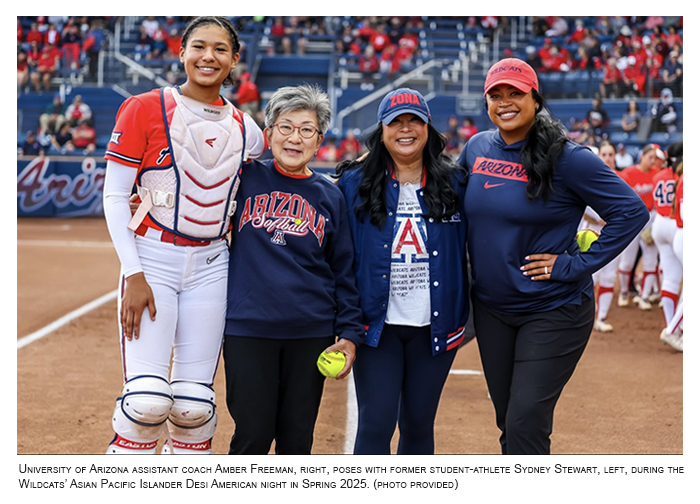
Freeman said, “APIDA Heritage Month means a lot to me because it’s a chance to celebrate the culture, resilience, and pride that I carry as a Filipino athlete and coach. In our game, representation matters, and I’m proud to honor my roots while inspiring young women to embrace who they are both on and off the field.”
Having coaches like Freeman to help players feel seen and connected is what allows players like Sydney Stewart to play to their full potential.
This impact can also be felt with Mississippi State University head coach Samantha Ricketts, who intentionally wants her program to “feel like a family.” She prides herself in making sure that when she recruits Samoan and other Polynesian players, they can be comfortable and flourish away from their families when often making a cross-country move to Mississippi.
While moving far for college softball is not a unique struggle for APIDA athletes, the ability to get proper exposure for recruiting purposes does effect grassroots coaches in places like Hawaii more than their continental United States counterparts.
LK Black (Hawaii) head coach Josh Danz explained, “the biggest obstacle our players face is exposure.”
To get seen by college coaches, his players stay in the continental United States for up to six weeks a summer, averaging 25,000 miles of flight time. This disproportionate financial burden is something the LK coaches don’t take lightly.
By helping to supplement monthly dues, Danz and the rest of his coaching staff have been able to develop nearly 40 student-athletes into Division I commits over the last five years. None of this would be possible without the work ethic and pride these players compete with, as they proudly represent Hawaii on the national stage.
“A lot of them come from nothing, and scratch and claw for everything they have,” he said. “They will run through a wall, jump headfirst over a fence, and leave it all on the line for their coach.”
“So, when they get the opportunity, they will go down fighting for themselves, for their team, and for their state.”
Having coaches like Sataraka at premier programs like UCLA allow these players to not only have someone to look up to, but also help guide them on their softball journey once they get to college.
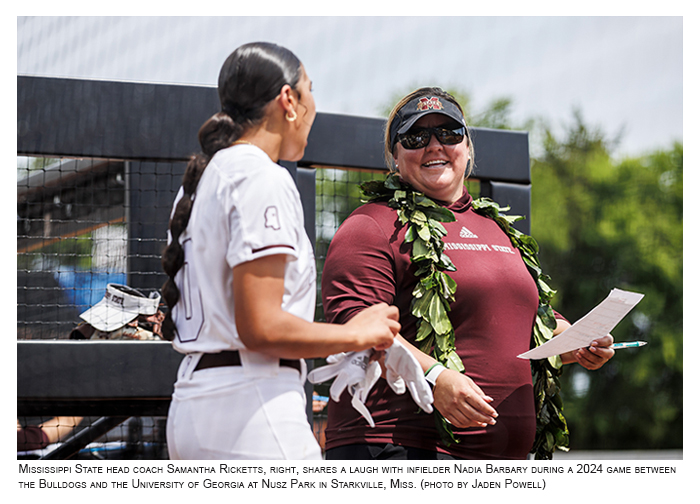
This past November, Ricketts was named the head coach of the American Samoan National Softball Team. When asked if she would take the job, Ricketts said, “It was an immediate yes.”
Ricketts said coaching the National Team was important to her to give back to a community that means so much to her. She stated that she wants to be able to honor the work that has come before her while also building a future where America Samoa is competing for an Olympic medal.
Short term, the goal is to qualify for the 2028 Los Angeles Olympics. Long term, the goal is to create a foundation for a National Team that will compete annually through WBSC events and the 2032 Olympics. Ricketts joked that the Samoan culture is built to play softball. To play a team sport. She said the backbone of the Samoan culture is based off “family and pride.”
None of this work could be possible without the help and guidance from the American Samoan Softball Association. With the support of the AIGA Foundation and specifically George Malauulu, current and past NCAA softball players have been able to return to America Samoa to coach softball clinics and help grow the game. It’s events like this that mean so much and is exactly why we all coach. To grow the game.