By DR. GLEB TSIPURSKY, CEO, Disaster Avoidance Experts
A coach does not need another shiny platform. A coach needs 45 minutes back before practice, a cleaner message to parents, a faster way to find the five clips that actually matter, and fewer administrative loose ends at the worst possible time of the season.
That is the real promise of practical AI adoption in fastpitch: not replacing judgement, instinct, relationships, or the feel for a player’s confidence in the batter’s box, but removing enough friction that coaches can spend more time coaching. The danger is that AI is being sold like magic. Coaches know better. Under pressure, magic does not win games. Repeatable systems do.
The first question is not “What can AI do?” It is “Where are we losing time every week?” For most softball programs, the answer is not mysterious. Coaches spend hours writing updates, organizing travel details, responding to repeated questions, reviewing video, preparing scouting notes, tracking recruiting communication, and turning messy information into decisions. That work matters, but much of it follows a pattern. Patterned work is where AI can help.
The early wins should be boring. That is a compliment. Use AI to turn a rough set of notes into a clean team email. Ask it to create three versions of the same message: one for athletes, one for parents, and one for staff. Feed it your practice priorities and ask for a draft agenda with time blocks.
Use it to summarize a staff meeting into action items. Use it to create checklists for tournament travel, equipment needs, fundraising reminders, preseason onboarding, or camp follow-up. The best AI tools are often most valuable when they reduce the communication and coordination drag that keeps leaders from higher-value work.
That does not mean handing over the program voice. AI should draft. Coaches should decide. The head coach’s tone, standards, values, and timing still matter. A message about playing time, team culture, or accountability cannot sound like it came from a corporate help desk. The coach must edit for truth, warmth, and specificity. AI can make a first draft faster. It should not make the final call.
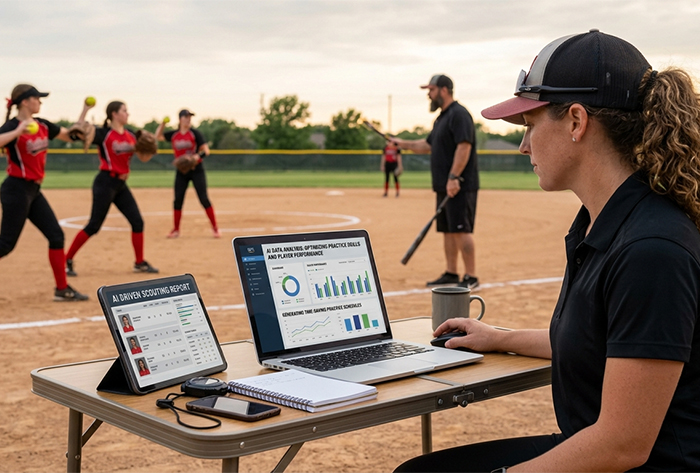
Video is the next obvious opportunity. Coaches already understand film better than most professions understand data. The question is whether new systems can make video analysis faster without making it shallower. A useful tool should help a staff find patterns: first-pitch swings, chase zones, defensive positioning, pitcher tendencies, baserunning decisions, or recurring breakdowns in bunt coverage. A poor tool overwhelms the staff with dashboards and labels that look impressive but do not change practice.
Here is a simple test: After using the tool, can the staff make one clearer coaching decision in less time? If the answer is yes, keep testing. If the answer is no, the tool is entertainment.
Recruiting requires even more discipline. The NCAA reminds athletes and families that recruiting communication depends on division, grade level, timing, and context. AI can help organize contact notes, draft compliant templates, summarize athlete profiles, or prepare follow-up reminders. It should never become an autopilot for sensitive communication. Coaches still need to know the rules, check the calendar, and make sure every message reflects the program’s actual interest and values.
The same caution applies to athlete information. Any tool that touches grades, health information, contact details, performance notes, or recruiting records raises trust questions. The U.S. Department of Education’s guidance for ed-tech vendors makes clear that student data requires careful handling when third parties collect or use personally-identifiable information. A coach does not need to become a privacy lawyer, but every program should ask basic questions before uploading anything sensitive: Who can see this data? Is it used to train the system? Can it be deleted? Has the school approved the platform? What happens if an athlete transfers?
Those questions are not obstacles to innovation. They are part of coaching responsibly.
The strongest AI strategy starts with a small trial, not a full-program rollout. Pick one recurring pain point. Choose one tool. Define success before the trial begins. For example: “Can we cut weekly parent communication time from 90 minutes to 30 while improving clarity?” Or “Can we identify five teachable video clips within 20 minutes after a game?” Or “Can assistants turn practice notes into player-specific follow-ups without adding another evening of work?”
Then run the trial for two to four weeks. Keep the stakes low. Do not test a new system for the first time during postseason preparation, a recruiting crunch, or a high-conflict team issue. Coaches would never install a new defensive scheme on game day and hope everyone figures it out. Technology deserves the same respect as practice design.
The biggest mistake leaders make is assuming staff adoption will happen because the head coach is convinced. It rarely works that way. The assistants, operations staff, graduate assistants, volunteer coaches, and players all experience the change differently. One person sees a time-saver. Another sees another login. Another worries that their judgment is being second-guessed. Another tried a chatbot once, got a bad answer, and decided the whole category is useless.
This is where AI workflows matter more than AI enthusiasm. A program should decide who uses the tool, for what task, at what point in the week, with what review step, and under what limits. Without that structure, AI becomes either a toy for the early adopters or a burden for everyone else.
A good staff rule is simple: AI may suggest, summarize, draft, sort, and surface patterns. Humans must verify, personalize, decide, and own the outcome. The National Institute of Standards and Technology’s AI risk management framework offers a useful lens here: govern the tool, map the risks, measure performance, and manage what happens when the output is wrong. In coaching language, that means no blind trust. Watch the reps. Review the film. Adjust.
The human side also includes athletes. Players need to know when AI is being used and why. If a program uses AI to help organize video clips, that is different from using it to rank players without explanation. If AI helps draft individualized development notes, the coach should still deliver the message as a coach. Trust erodes quickly when athletes feel processed instead of coached.
The same principle applies to team communication. AI can make information clearer, faster, and more consistent. It cannot read the room after a tough loss. It cannot know which athlete needs a direct challenge and which one needs reassurance. It cannot replace the quiet conversation that prevents a small frustration from becoming a team problem. Coaches should use AI to create more space for those moments, not fewer.
The best programs will not be the ones that buy the most technology. They will be the ones that build the clearest habits around it. They will identify time drains, run small trials, protect sensitive information, train staff patiently, and insist that every tool earn its place. They will treat AI as they treat every other part of performance: useful only when it helps people execute under pressure.
Fastpitch has never been just about numbers. The stat sheet matters, but so do rhythm, confidence, preparation, communication, and trust. AI can support all of those when coaches keep it in its proper role. Let it handle the repetitive work. Let it sharpen the first draft. Let it speed up the search for patterns. Then let coaches do what coaches do best: make sense of the moment, lead people well, and turn information into performance.
Dr. Gleb Tsipursky, called the “Office Whisperer” by The New York Times, helps tech-forward leaders stop overpaying for AI while boosting engagement and innovation. He serves as the CEO of the AI consultancy Disaster Avoidance Experts. Tsipursky has written seven best-selling books, and his forthcoming book with Georgetown University Press is The Psychology of AI Adoption at Work: From Resistance to Results (2026). Prior to that, he wrote ChatGPT for Leaders and Content Creators (2023). His cutting-edge thought leadership was featured in over 650 articles in prominent venues such as Harvard Business Review, Fortune, and Fast Company. Tsipursky’s expertise comes from over 20 years of consulting for Fortune 500 companies from Aflac to Xerox and over 15 years in academia as a behavioral scientist at UNC-Chapel Hill and Ohio State.