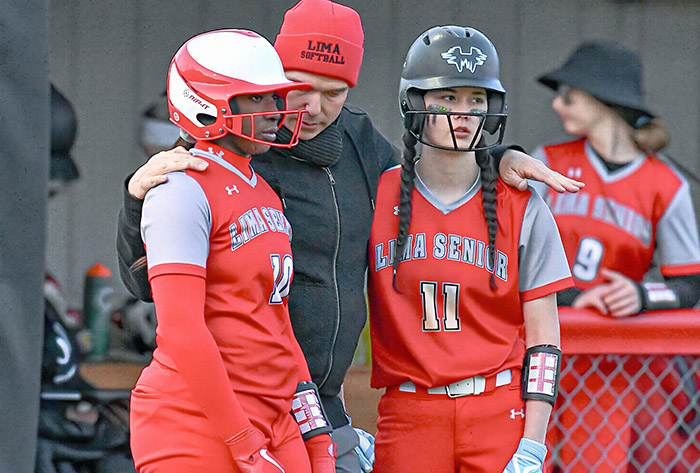
Rob Nelson is a well-known travel ball and scholastic coach in Ohio. The longtime head coach at Lima Senior High School, Nelson is also known for his run as the popular owner of the No. 1 regionally-ranked Lima restaurant, The Met, and for his work developing real estate in that same downtown area. He holds a PhD and is a former college professor of statistics and psychology.
Nelson took a few minutes to answer 20 questions for the NFCA …
What is the very first thing you do with your team when starting a new season?
After tryouts, I have a team meeting with the parents and students so we are on the same page. While this might seem normal, our meeting takes on a different tone given our circumstances. Many of my players have to work to help support their family. We work around their work schedules and try to make sure that our parents understand our training goals. Our boys hoops team is always quite good and we have to share a gym with boys basketball, girls basketball, baseball and lacrosse. Success for us starts with 5 a.m. practices for 50 percent of the preseason. That takes a special commitment for families because of transportation, especially underclass students. We set the tone with times, grades and standards and move forward, together. Have not had a problem with this in years. We pride ourselves as being the first high school to practice in the region/state. It allows our students to perform their familial and sport responsibilities with the least resistance.
What one characteristic must every person who plays for you have?
Growth mindset.
Why did you get into coaching?
The young female softball players (aged 6-8) needed a place to play and a coach to lead. I coached a coed team of t-ballers. There are not a lot of volunteers for girls sports in our area. That was 15 years ago.
What is the most difficult part of being a coach?
Seeing financial and community disparities and working to give our kids a fighting chance. It’s psychological on my part. The hardest thing is losing 32-1 against a team that clearly has personological and socioeconomic variables that predict to success and yet, they pile on the runs and think nothing about it. I am left picking up the pieces and turning it into pearls of wisdom for later use.
What is the most rewarding thing about being a coach?
When I am told about the impact I made in their lives outside of softball. When I see players still friends a decade after being teammates. When I see players working with each other in the private sector after softball. When a dad of a player passes away and our journey together for his daughter was so transformative, they have our shirt or hat in the coffin. While it might be morbid, it tells you what an impact we can have on families and communities when we put the players first.
If you could have dinner with three other coaches from any time in history, who would they be?
Pat Summitt, Emma Hayes or Kathy Delany-Smith
Softball-specific: NFCA Hall of Famers Lonni Alameda, Carol Hutchins, Mary Higgins
What is the one thing in life or coaching you won’t compromise on?
Advocating that women and my female student-athletes have a voice and seat at the table, always. Leverage what I have to get them the things they need.
What is the one thing you personally feel you need to have to succeed as a coach?
My supportive and loving wife, Nicole. Without her, these things, my time, is not possible. While I may be active in the lives of over 70 student-athletes each year, the No. 1 relationship is with my wife, Nicole.
How do you define success?
Process over outcome. I coach in an inner-city, urban and poor, the sixth-poorest school district in the state. We are out-spent, and usually, our resources, not just monetary, are fractions of our competitors. We take the long-game view and I try to help all my student-athletes find success in the process. I am lucky in that my school system supports what we do to help the whole student. If the students understand process, they can be successful in life when softball is over, because for most of them, softball will be over by the time they are 19. I want them living a healthy, civically-engaged life when they are 29, 49 and beyond. The seeds are sewn with us, however, in middle and high school.
What makes a great coaching staff?
Putting egos aside. Having a leader that is omni-present and allows the staff to do complete their roles with just the right amount of oversight and mentoring. I think, too, that you need to have a relationship outside of the facility to build deeper bonds.
What is the most important thing you’ve learned from a loss?
It never defines who we are unless we allow it to.
What is a goal you have for YOURSELF over the next 12 months?
Take time away, just a little bit, from others to watch my daughter, who is in her last college season at UChicago, play. I have missed over 70 percent of her games, live, because I have been helping others and I have had to tell myself that it is OK to take a few months away so I can enjoy her last ride. Selfishly, while it is her ride, I feel like it has been ours, even though she is playing. While doing that, I have to be very intentional with my staffs to make sure everyone gets the training they need while I step away for just a little bit. This takes a lot of planning and communication.
What is an objective you have set for your TEAM for this next season?
Be the best student of the game so you can process your actions for a more positive experience.
What would be an area in your coaching you’d like to improve?
Creating an environment where more younger coaches want to be a part of the system so we can positively affect more kids in our community. I can’t just be concerned about my team. I have to help mentor coaches to move the game forward.
What would you want a former player to say about you?
I was the best coach they ever had because I cared about them as a whole person.
What do you feel is the most important thing a coach can provide to their players?
Presence. When your job is on this line due to outcome measures (wins, league championships, etc.) it’s hard to meet our athletes where they are at sometimes. Developing relationships that stick takes additional time and effort. We have to allow for that to happen. I have to understand where they are at, not just athletically, and intervene in ways where the message can be consumed.
How would you describe your coaching style/philosophy?
Phil Jackson-esque. Allow the athletes to be athletes. Let them tell you what is going on instead of always telling them what you see.
What piece of advice would you give a fellow coach?
Never be demeaning. Know your strengths and surround yourself with people smarter than you so you can learn.
What do you do for fun in your downtime?
Smoking meats (I own a restaurant so there is not much down time), baking desserts from scratch and throwing front toss to my daughter who is in college. Long bike rides along Lake Michigan in Chicago.
What would someone be surprised to learn about you?
My music selection. Playlist has Kendrick Lamar, U2, Olivia Rodrigo, Morgan Wallen, Pete Rock and CL Smooth, Bruce Springsteen, Tee Grizzley, Green Day, LL Cool J, Blink 182, Ella Langley and The Indigo Girls. Very eclectic. Players and students are surprised when I know all the lyrics and use them during drills.