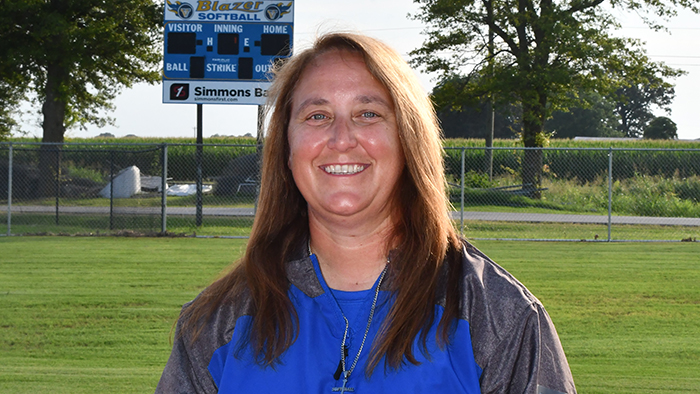
Karen Sanders is the head coach at Valley View High School in Arkansas and a longtime coach and educator who has led teams to state championships in three different sports.
She is in her first year as the High School Representative on the NFCA Board of Directors and also serves as the Executive Director of the Arkansas High School Fastpitch Coaches Association.
Sanders took a few minutes to answer 20 questions for the NFCA …
What is the very first thing you do with your team when starting a new season?
The first thing we do is paint the big picture. I lay out what our weeks and season will look like so both new players and returners can see where we’re headed. Then our leadership group drafts their “families.” No one walks this season alone. Every player has a small circle to lean on when they’re struggling, confused, or just need someone in their corner. Those small support systems help us unite faster and grow stronger as one.
What one characteristic must every person who plays for you have?
Communication is non-negotiable in our program. From managers to coaches, everyone has to learn how to speak up and listen well. It doesn’t happen overnight, but we build it intentionally. I’d also say honesty. Honesty is a choice. When someone chooses truth — even when it’s hard — it tells me everything I need to know about their character.
Why did you get into coaching?
I was actually in college playing basketball and intended to be a chemist. After a car accident forced me to sit out a semester, my high school coach, Nancy Cherry, asked me to help her basketball team. That season changed everything. The chance to teach, model character, and build relationships in a competitive environment hooked me. Coaching didn’t just become my job — it became my calling.
What is the most difficult part of being a coach?
The hardest part is guarding against burnout. This profession can impact you to your core. If you stay in it long enough, there will be moments that shake you. I’ve had to learn not to take everything personally and to step away when needed. Having a tribe that reminds me who I am during the lows has been essential.
What is the most rewarding thing about being a coach?
The relationships. Hands down. When a former player sends a random text, introduces me to her family years later, or wants to reminisce about old memories — that’s everything. My college coach, Barney Hay, once told me, “You may never know the true impact you had until years later, if at all.” I carry that with me. Each player takes a piece of my heart when she leaves, and that never changes.
If you could have dinner with three other coaches from any time in history, who would they be?
First one is Pat Summitt. I realize she's not a softball coach, but she is a huge pioneer in women's sports overall and has impacted my career from afar during her lifetime. The other two by far are easy to choose: Carol Hutchins — her fight for women's sports, doing it the right way, working hard for her teams, from a distance impacted me — and Terry Flenor, a retired high school coach from Beebe (Ark.). His teams were always prepared, well-disciplined, hard-working, and pushed me to be better. We had a lot of heated battles, but he was and still is always up for a conversation on the game and how to be better.
What is the one thing in life or coaching you won’t compromise on?
Authenticity. I won’t pretend to be someone I’m not. The way I love, lead, and even my quirks — that’s how I connect. When I stay authentic, I attract the right people and get the best out of them.
What is the one thing you personally feel you need to have to succeed as a coach?
Athletes. Obviously (laughs). But truly, adaptability. The game changes. Kids change. Culture changes. If I’m not learning and growing while staying grounded in who I am, I’ll get left behind.
How do you define success?
Success is giving my absolute best, staying open to growth, and inspiring others to believe they can do more than they thought possible.
What makes a great coaching staff?
A great coaching staff is willing to have open dialogue about what is best for the team, accepting of critical conversations that may be uncomfortable — but needed — being able to support one another, and, maybe the most important one, trust in each other.
What is the most important thing you’ve learned from a loss?
Losses have taught me to evaluate honestly — the good, the bad, and what must improve. When I take ownership first, my players follow. Growth comes if you’re willing to face it.
What is a goal you have for YOURSELF over the next 12 months?
I hope to continue to grow: knowledge of the game, being authentic to who I really am, teachable in the mental aspect of the game and mind, and our state association to help more high school coaches and players in different aspects. I hope to eventually find my way into the college coaching arena.
What is an objective you have set for your TEAM this season?
ONE. We want to be one in the dugout, on the field, in the locker room, and outside of softball. Unity doesn’t happen accidentally — it’s a daily choice to stay connected.
What would be an area in your coaching you’d like to improve?
Learning to be a great communicator to all the pieces of your program: parents, staff, bus drivers, administration, players, media, etc. Making sure the message is received for those who may not know our program or the situation. It's a constant growth area for myself.
What would you want a former player to say about you?
I hope they’d say I believed in them, challenged them, and never stopped being in their corner — even long after the uniform came off.
What do you feel is the most important thing a coach can provide to their players?
A safe place to fail and learn how to respond. Life guarantees failure and heartbreak. If I can teach them how to fail with grace and rise again, that’s the greatest gift I can give.
How would you describe your coaching style/philosophy?
I’m a fundamentals-first coach. We master the little things, then apply them in live situations. I ask a lot of questions because I want to understand how my athletes think. Knowing their thought process helps me coach the whole person, not just the player.
What piece of advice would you give a fellow coach?
It’s okay not to have all the answers. In a world where information is instant, humility still matters. Tell your players when you don’t know — and then model how to learn.
What do you do for fun in your downtime?
In my downtime, I enjoy being on adventures with my family. If you want my true heart, I am probably on the water fishing or at the beach listening to the ocean or in the mountains enjoying nature. I love the outdoors and God's masterpiece.
What would someone be surprised to learn about you?
Softball has always chosen me. I was playing football in my yard with the neighborhood boys when a travel ball coach asked my parents to play (slowpitch). In college, we were starting a program (I was playing basketball) and they needed players — I said yes. Professionally, I started as a dedicated basketball coach, but because my resume had I'd played in college, I was given the opportunity to coach softball. The game keeps finding me, and I try to honor that by giving everything I have back to it.