
The fact that Grace Price is one of the top hitters on her University of the Ozarks team is impressive. That she is thriving this season despite not having played a full game since age 15 is downright amazing.
Price, the Eagles’ starting right fielder, has a rare joint condition called osteochondritis dissecans, where a small segment of bone and its overlying cartilage separates from the surrounding region due to lack of blood supply. She has endured 10 knee surgeries, which includes a bone and cartilage transplant in her right knee her junior year of high school.
“I’ve had maintenance surgeries since then to keep it from completely failing,” she said, quipping, “I really don’t have a good leg to stand on.”
While both knees are seriously compromised, Price’s right knee, which has reached stage 4 — the most serious level of the condition — is the worse of the two. Doctors have tried any number of things over the years to help alleviate the condition, including grafts of her own bone and procedures to encourage blood flow in the region.
Still, Price has played in all but one of her team’s 40 games this season, ranking sixth in hitting on a roster of 27. She has since cooled off, but over the Eagles’ first 29 contests she hit .370, which ranked second overall on the team.
“Truthfully, I wasn’t supposed to come back this season,” Price said. “I was supposed to have a knee surgery to follow up in August (2025), because they had told me I had a lot of issues and I was going to have to stay on top of it, and it came to a point the pain had gotten so bad that I agreed with them. My leg had been giving out and I couldn’t even walk to my job (as a summer intern at an agricultural non-profit in Washington, D.C.).”
But late last summer, everything changed.
“I’m a religious person, and I had been arguing with God about it,” Price explained. “I don’t really know how to explain it, other than when I stepped foot back in Arkansas, I could walk again. And it was a moment of, ‘Let’s see if I can do this, let’s see if I can do that.’ And then I started trying to hit again and I was like, ‘OK, I can hit.’”
“My doctor is a well-established doctor at Mizzou, and he’s like, ‘I don’t know how to explain it, either. It’s not me.’”
But her softball coach was putting the brakes on the idea of the team manager trying to play after so many years and so many medical procedures.
“Then, I heard we were getting a new softball coach, and I was like, ‘Is this a door opening?” Price said. “I started asking my teammates, ‘Would it be OK if I tried?’ and they all said yes.”
“I got here in September and I didn’t know if Grace was a player or a manager,” current head coach David Kuhn said. “Everyone but me knew Grace was the manager. She just walked on through and told the girls, ‘I’m going to play,’ and she has.”
“It’s good I didn’t know her history, because I probably would’ve had a biased opinion.”
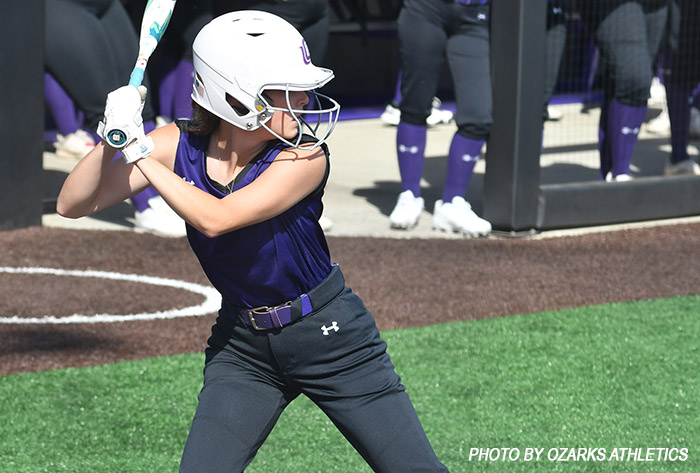
“It’s crazy,” he continued. “Her first at-bat she got a hit and I was just so tickled. I was like, ‘You’re living right!’ and then she got another hit, and finally I realized that she’s just a really good hitter — great hand-eye coordination.”
Which is especially important, since she can’t use her legs to hit like everyone else, and hasn’t seen live pitching since age 15. Maybe don’t tell that last part to opposing pitchers.
“Her knees are swollen all the time,” Kuhn said. “She has to front-foot a lot of things, kind of like (Baseball Hall of Famer) George Brett. But she’s always on time. And she’s also really amazing on defense, catches everything, and smart on the bases.”
He talked about her leadership qualities.
“It’s been tremendous. It’s just like having another coach on staff,” Kuhn said. “She’s our team advocate. When someone’s having trouble with a teacher and they go to talk to them (and bring Price along), the teacher’s like, ‘Who’s this’ and they’re like, “This is my attorney.”
Kuhn laughs at this before explaining that Price, who is majoring in political science and wants to attend law school, has a great ability to navigate difficult situations.
“She’s got no problem being argumentative,” he said. “She’s always level-headed and grounded, and has everyone’s best interests in mind. It’s never an ulterior motive. Sometimes she’s nice to a fault.”
“There’s been one or two times when people have been kind of rude to her, and we have 27 players, so it makes a lot of people mad, like, “How could you be rude to Grace?’”
She has been nicknamed, “The Senator,” in recognition of her service to her teammates.
“Coach K came up with that,” Price said. “I’ve always had girls on our team say if I ran for President, they would vote for me and all that kind of stuff.”
“I certainly would!” Kuhn interjected.
“There’s a balance between being a problem-solver, but also being kind and having that perspective,” Price explained. “You can be a leader and have a hard hand, and also be somebody that’s a good person and treats people how you’d like to be treated.”
“And she always right!” Kuhn said, breaking both himself and Price into laughter.
Price’s ultimate goal is to become a judge, but in the meantime, she is deciding on where to go to law school.
“I want to do agricultural or environmental law, because I’m interested in helping farmers and interested in conservation,” she said. “The two go hand in hand. Conservation can end up helping the farmer, and the farmer can help conservation efforts. That is something I learned in D.C. as well.”
The University of Oklahoma and Tulsa law schools have reached out, and the University of Arkansas at Little Rock has not only accepted her, but also offered her their prestigious 50 Merit scholarship, which would cover half of her tuition there.
“When I found out about my knees, I was playing multiple sports,” Price said. “It wasn’t the only sport I lost, but it was the sport that I missed the most.”
“I had tried in high school to go back to it, I just was not successful. I always had to have another knee surgery. When I got to college, it felt like my opportunities had ended.”
But her oldest brother, who was attending Ozarks and playing baseball, inspired her to get involved with the softball squad after she transferred in from the University of Arkansas, where she had started her college journey on a band scholarship.
“He was like, ‘Grace, this program is unique enough that you might slip in and be a manager, if you really want to be around it,’” she said. “I told myself being around it was better than nothing, that’s how much I liked it. So, I’d be a manager, if that’s what it took.”
“But then doors started opening, and that helped me gain this opportunity.”
Many of the newer players on the team were surprised to learn Price had gone through so much physically, because they have just seen performing in practice and games.
“I’m always in softball pants and never bring it up or have used it as an excuse,” Price said. “Some of them have been shocked to hear I’ve had so many surgeries. They had never heard of that before. I think they’ve been pleasantly shocked and hopefully excited to play alongside me.”
“People assume because I’m playing, that means I’m completely healed,” she said. “I’ve been taking care of it, trying to ice and see our trainer and make sure nothing looks concerning.”
She has embraced the fact that sharing her story may have helped others.
“A couple of people have reached out after hearing and said that’s an encouragement to them to see success from someone who probably should have given up,” she said. “You never know when something you are going through is going to help someone else.”
Kuhn, who is the winningest coach at two colleges in a long and distinguished coaching career, is quick to admit he has never seen anything quite like Price’s journey.
“This is a Netflix story,” he marveled. “This stuff doesn’t happen.”