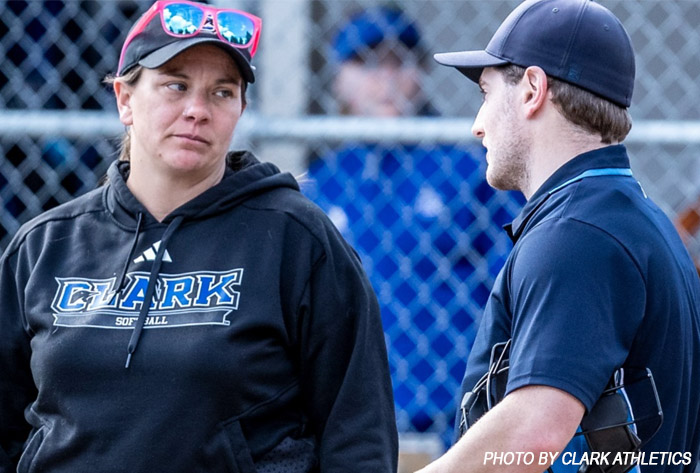
By CIERA JONES, Head Coach, Clark College
Our softball worlds are often smaller than we realize.
Last December, I attended my first NFCA Convention and ran into former teammates, players, and even coaches from my 14U days. It was a reunion of a tightly-woven network, one that had quietly shaped my understanding of the sport.
Growing up, that network was even more contained. My high school teammates’ parents had coached my rec teams. The players I faced on Friday nights were often the same ones I played alongside on travel ball weekends.
I was raised in a suburban community that invested in softball. By my senior year, our high school battery paired a Pac-12 Conference commit with a catcher headed to the Southeastern Conference. In that environment, elite talent felt normal and expected.
It wasn’t until after college, when I moved to a rural town 100 miles from the nearest stoplight, that I began to understand just how small my world had been.
Like many former athletes, I was navigating the identity loss that comes with the end of a playing career. In an effort to reconnect with purpose and community, I volunteered as a coach at the local high school. The athletes I met were gritty, coachable, and deeply committed, but they lacked access. On game days, they missed entire school days, leaving early in the morning and returning near midnight because the closest competition was hours away.
That experience revealed something I hadn’t fully grasped before: Opportunity in softball is not evenly distributed. It is shaped, often dramatically, by geography and the culture surrounding it.
The Geography of Opportunity
Some places naturally evolve into athletic ecosystems, a combination of culture, infrastructure, and access that produces consistent excellence. Consider Warroad, Minn., a town of fewer than 1,800 people that has produced multiple Olympic hockey players. Or look at how deeply football is embedded in communities across Texas.
Softball has its own hotspots, regions where travel ball is accessible, college exposure is routine, and private instruction is normalized. But for every one of those hubs, there are communities left off the map, places where athletes must overcome not only their opponents, but also distance, cost, and limited visibility.
Lindsay Davies, a high school coach in Burns, Ore., describes the reality.
“We just don’t have a large enough town to field more than one team per age group in middle school,” she said. “To find competition, we drive 2.5 to 5 hours. Most teams won’t travel to us, so it’s all away games. The cost of fuel, hotels, and food adds up quickly and limits who can participate.”
This is not an isolated experience, it is structural.
The Recruiting Gap
In online recruiting forums and Facebook groups, a recurring question surfaces: How does a rural athlete get seen?
College coaches like those at Linfield University have found success recruiting players from small towns, including athletes like Tayah Kelley, the NFCA Division III Pitcher of the Year in 2024. These players often arrive less polished but bring something equally valuable: Resilience, adaptability, and work ethic forged in environments with fewer resources.
Still, the system tends to reward visibility. Showcases, travel circuits, and recruiting camps are often geographically and financially out of reach for rural or lower-income athletes. When exposure becomes a prerequisite for opportunity, entire populations are unintentionally excluded.
Rethinking Diversity in Softball
When we talk about diversity in softball, the conversation often centers, rightfully, on race, ethnicity, and gender. But diversity is broader than demographics.
It includes:
- Geographic diversity (urban vs. rural)
- Socioeconomic diversity (access vs. limitation)
- Developmental diversity (early specialization vs. late entry)
- Cultural diversity (how different communities understand and value sport)
A player from a remote ranching town and a player from a suburban travel-ball pipeline may share a position, but their paths, perspectives, and problem-solving approaches can be vastly different. That diversity is not a challenge to overcome; it is an asset to embrace.
Expanding the Game
If we want softball to grow, not just in numbers, but in richness, we need to think more expansively about access and inclusion.
- Invest beyond traditional hubs
Organizations like Little League Softball and MLB's Reviving Baseball in Inner Cities (RBI) show what’s possible when resources are directed toward underserved communities. Similar models can be expanded to rural regions through equipment grants, coaching education, and regional development programs. - Rethink talent identification
Metrics like exit velocity and spin rate matter, but so do qualities like adaptability, coachability, and leadership. Coaches must be willing to look beyond traditional pipelines and evaluate the context in which performance occurs. - Leverage technology to close gaps
Video platforms, remote coaching, and virtual recruiting tools can help bridge geographic divides. While not a complete solution, they offer rural athletes a way to gain visibility without the same level of travel. - Tell more inclusive stories
Media coverage and storytelling shape perception. Highlighting athletes from nontraditional backgrounds, whether rural, first-generation, or multi-sport, broadens what success in softball looks like and who feels invited into the game.
Beyond the Diamond
Softball has always been more than a game. It reflects our communities, our values, and the systems we build around opportunity.
Expanding diversity in softball isn’t just about fairness, it’s about possibility. When we widen the lens to include different geographies, experiences, and pathways, we don’t dilute the game, we strengthen it.
Because somewhere, far from the nearest showcase field or recruiting camp, there’s a player with the potential to change the game.
The question is whether we’re willing to meet them where they are.